How AI quietly fixed the worst part of networking
Nobody ever hated meeting people. They hated the admin afterwards. Here is how AI is removing the typing, sorting and forgetting from professional networking in 2026.
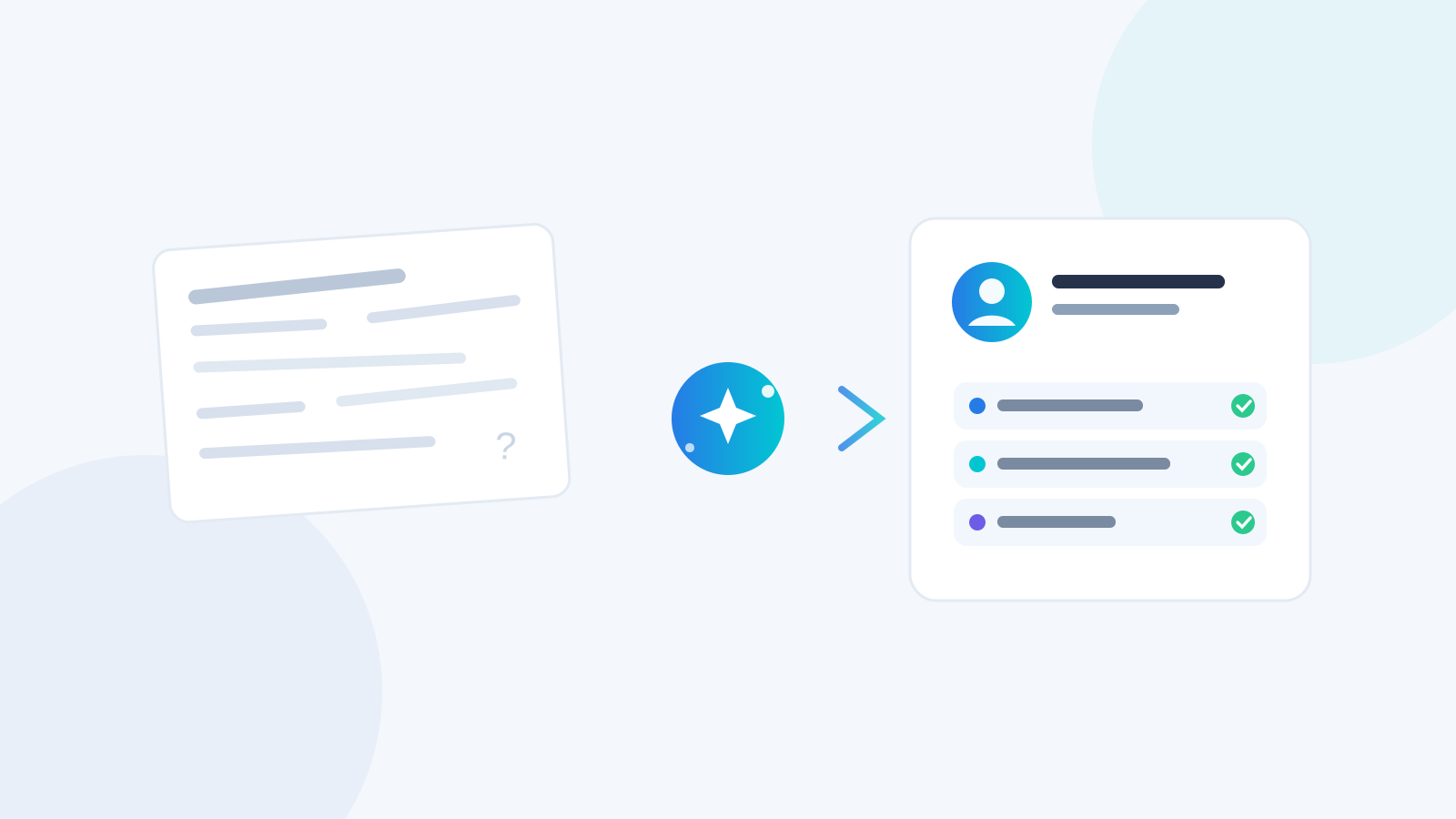
The worst part of networking was never the networking. Meeting people is the point, and mostly a pleasure. The part everyone hated was the aftermath: the stack of cards to type up, the "who was this?" photos of cards in your camera roll, the contact saved as "Ranjith Expo??" that you find eight months too late. Networking has always been ten minutes of conversation followed by an unpaid data-entry job, and the data-entry job is where the value quietly died.
That job is disappearing, and AI is what is removing it. Not the flashy kind that writes poems, but the patient kind that reads a business card properly.
What does AI actually do in modern networking tools?
It turns messy real-world information into a clean contact without you typing anything. Across the digital business card industry this has become the defining 2026 feature; nearly half of providers now ship some form of AI-assisted contact capture and lead handling, and the analysts tracking the category call it out as the main engine of its growth.
Concretely, in TapID it works like this. You scan a paper card with your phone. On-device text recognition reads the print, and then an AI pass does the part that used to be your job: deciding that "PERERA & SONS (PVT) LTD" is the company, that the bold line is the name, that the second number is the WhatsApp, and that "Chartered Accountant" belongs in the designation field. What lands in your leads inbox is a structured, searchable contact, not a photo of chaos.
The difference sounds small until you have scanned a card in a decorative font, printed sideways, with three phone numbers. Plain text recognition gives you the letters. The AI gives you the person.
Why does clean data matter so much?
Because follow-up runs on findability, and findability runs on structure. A contact whose company, role and industry are in the right fields can be searched, filtered, and remembered. Three weeks after an exhibition, "the logistics director from the Galle Face event" is either a two-second search or a lost deal, and the difference was decided at capture time.
This is the unglamorous truth behind every networking outcome: the winners are not the people who met the most contacts, they are the people whose contacts survived in usable form. We built our whole exhibition playbook around that principle, and AI capture is what makes it effortless enough to actually happen at a busy booth.
Where does AI stop and honesty begin?
A fair question, because this industry is drowning in AI claims. Our rule: AI is allowed to clean and organise, never to invent. If a card does not show an email, no email appears; the system will not guess one into existence. When the AI reading is unavailable, the app says so plainly and falls back to basic reading rather than pretending. And card scans stay yours, attached to your contact, not mined for anything else.
The goal is a smaller, humbler one than the hype suggests: give you back the ten minutes after every conversation. Multiplied across a year of networking, that is days of your life returned, and a contact book that actually works.
What is coming next?
The direction across the industry is clear: capture is becoming universal. Paper cards, contact QR codes, LinkedIn codes, digital cards from any platform; the tools that win are the ones that can receive a contact from anywhere and hand back clean data every time. We wrote about that two-way world in They have a card too, and it is where TapID is building.
The endpoint is worth naming. Networking is heading back to what it was before the admin arrived: you meet someone, you talk, and the record keeping simply happens. The technology's highest achievement will be that nobody notices it anymore.
The bottom line
AI did not change what networking is. It removed the part that was never networking at all: the typing, the sorting, the forgetting. What is left is the conversation and a contact book you can trust, which is all anyone ever wanted from a stack of business cards in the first place.
Ready to network smarter?
Create your free TapID profile in minutes, or pick a card that makes your next introduction unforgettable.